Every class, in one place.
All taught in person, hands-on in the shop service bay. The tag on each class is its format. Classes are booked through the host, usually your rep. Not sure who that is? Email us and we'll point you to the next one near you.
Two formats with hands-on. And lecture only, if you insist.
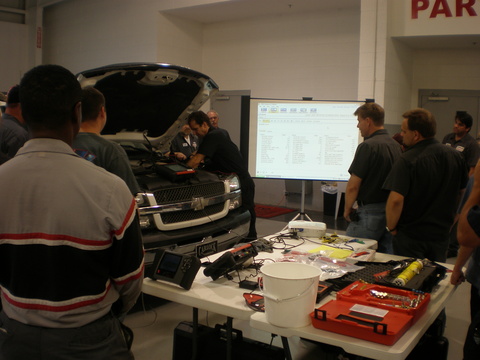
Two formats, both with the equipment in the room. The tag on each class says which.
Lecture and mini hands-on
A full lecture with hands-on built in, in one session, usually an evening. For the three starting classes: Step into the Scanner Operations World, The 101's of Lab Scope Operations and Diagnostic Operations, which also run full-length.
Full-length lecture and full-length hands-on
The whole class, with time to do the testing yourself: one long day, or two consecutive evenings. Every class runs this way, the format Pro Auto Tech has been known for since the 1980s.
Lecture only
Yes, we can do that. But would you want to? Everyone does that, and there is no hands-on.
Foundations
Where most technicians begin. Each of these stands on its own and sets up everything after it.
Step into the Scanner Operations World
Get the most out of the scan tool you already own: data PIDs, functional tests, bi-directional controls, and how to read what the scanner is telling you before you pick up anything else.
Diagnostic Operations
A working diagnostic process from the write-up to the fix: what to test first, what the results mean, and how to stop guessing.
Component Testing 101
How to test sensors, actuators, circuits and modules on the car with the tools in the bay: what good looks like, what bad looks like, and how to prove it.
Electrical Theory: Practical Drivability Electronics
The electrical theory a drivability technician actually uses: voltage drops, circuits, grounds, and the electronics behind the sensors and actuators you test every day.
Computer Engine Data
Reading computer engine data: what the PIDs mean, what normal looks like, and how to spot the one that is lying to you.
Lab scope operations and waveforms
From switching the scope on to reading what it shows you: the most-taught classes we run.
The 101's of Lab Scope Operations
Your first scope class. Setting up the scope, choosing time and volts, capturing a signal, and knowing what you are looking at.
Lab Scope Operations
Putting the scope to work on real circuits: sensors, actuators, ignition and more, with the setups and techniques that make a capture useful.
Lab Scope Operations of the Gas & Diesel World
Lab scope work across gas and diesel engines, side by side, for shops that see both.
Advanced Lab Scope Waveforms
Reading waveforms: known-good patterns, what the faults look like, and how to go from a capture to a conclusion. Then the advanced work: current ramping, multi-channel captures, and the setups that make the hard problems visible.
Digital Oscilloscope + Ignition
The digital oscilloscope from the ground up, then ignition on the scope: primary and secondary patterns, and what a misfire looks like before it sets a code.
Mutant Lab Scope
The lab scope class for technicians who have taken the others: unusual setups, unusual signals, and the captures nobody else takes.
Past the basics
For technicians who have the fundamentals and want a sharper process on harder cars.
Next Level Diagnostics
Harder cases, deeper testing, and a sharper process, for technicians who have the basics and want to go further.
Analytical Diagnostics
Thinking through the diagnosis: analysing data, waveforms and test results together to find the cause, not just the code.
New Millennium Diagnostics
Diagnostics for the vehicles on the road today: the systems, the data and the approach that current cars demand.
Symptom-Based Diagnosis
Start from the symptom instead of the code: no-starts, misfires, stalls, poor performance, and the tests that sort them out.
Technician Development Q & A
An open session. Bring your problem cars, your questions and your captures, and work through them with the instructor and the room.
Diagnostics Think Tank I to IV
Diagnostic problems worked through as a group, case by case. Four classes, each on its own theme.
Diagnostics Think Tank I
The first of the series: diagnosis worked through together, from complaint to cause.
Diagnostics Think Tank II: Under Pressure in a Vacuum
Pressure and vacuum as diagnostic tools: in-cylinder, intake, exhaust and crankcase, and what the readings tell you about the engine.
Diagnostics Think Tank III: Waveforms
Waveform-driven diagnosis, case by case, for technicians already comfortable on a scope.
Diagnostics Think Tank IV: Presets and Processes
Scope presets and repeatable processes, so the next hard car gets the same thorough approach as the last one.
One system at a time
A day on the system that's giving your shop trouble.
Mysteries of Gasoline Direct Injection (G.D.I.)
How G.D.I. works, how it fails, and how to test the high-pressure fuel system, the injectors and the controls behind them.
Mysteries of Electronic Fuel Injection
Port fuel injection from the fundamentals: fuel delivery, injector control, and the tests that prove each part.
VVT / VCT: Variable Valve Timing and Variable Cam Timing
Cam timing systems: how they work, the codes and symptoms they cause, and how to test actuators, solenoids and timing with scanner and scope.
Evaporative Emissions (E.V.A.P.)
The EVAP system and its codes: how the monitor runs, how to find the leak, and how to prove the fix.
OBD-II Data Modes
The OBD-II modes behind the scan tool: Mode 6, freeze frame, monitors and readiness, and how to use the data most technicians skip.
Global OBD-II
Generic OBD-II: what every vehicle has to give you regardless of make, and when to use it instead of the enhanced side.
Body Control Electronics 101
Body control modules and the electronics behind them: networks, lights, locks, windows and accessories, with an eye to what a body shop runs into after a repair.
A.D.A.S.: Advanced Driver Assistance Systems
Cameras, radar and the driver assistance systems behind them: what they do, what sets them off, and what calibration asks of the shop.
J-2534 Flash Calibration Programming
Module programming with a J-2534 pass-through device: the setup, the process, and the pitfalls.
Exhaust Emissions
Exhaust emissions as a diagnostic tool: what the gases tell you about combustion, fuel control and the catalyst.
On Board Diagnostics II
On-board diagnostics from the ground up: how OBD-II watches the engine, sets codes and reports readiness, and how to use that in the bay.
ADAS-TPMS
Advanced driver assistance systems and tire pressure monitoring in one class: what they do, what sets them off, and what service and calibration ask of the shop.
Diesel
For shops that run diesel through the bay, or want to.
Stage 1 Diesel Operations
The first diesel class: how diesel engines and their controls work, then the diagnostics: fuel systems, air management, aftertreatment, and the data and tests that go with them.
Diesel Engine Control Data 2.0
The second diesel class: engine control data on modern diesels, for technicians with Stage 1 behind them.
One manufacturer at a time
The engine controls and scan data of one make, for shops that see a lot of it.
Chrysler Engine Control
Chrysler engine management: how the systems work, the data they give you, and how to diagnose them.
Secrets of Ford Engine Control
Ford engine management from the inside: the strategies, the data and the tests that make Ford diagnostics make sense.
VW-Audi Scanner Operations
Scanner operations on Volkswagen and Audi: the data, the adaptations and the tests the scan tool gives you on these cars.
Get more out of what you own
Get Tuned-Up on your Diagnostic Platforms
Get more out of the scan tool you already own: the features, the shortcuts and the setups most owners never find.
Snap-On® Tools diagnostic platforms, past and present: Zeus and Zeus+, Triton and Triton-D8, Apollo, Apollo-D8 and Apollo-D9, Verus, Verus Pro and Verus Edge, Modis, Modis Ultra and Modis Edge, Solus, Solus+, Solus Edge and Solus Legend, Ethos Edge, Vantage, P1000, the MT2500 Scanner, Counselor I, II and XL, and the Sun Machine. Other makers' platforms are welcome too.
Making more power, keeping the drivability
Performance Tuning
Engine performance tuning: the controls, the data and the testing behind making more power without losing the drivability.
Making diagnostics pay
Dollars in Drivability Management
The business side of diagnostics: charging for diagnostic time, selling the test, and running the drivability side of the shop so it pays.
Ten to twelve months, one technician at a time
Not a class but a program, for the individual who wants to make the commitment.
Guru (10 to 12 month program)
For the technician who wants to become the best they can be in the world of drivability: a 10-to-12-month program, built around the work you do every day.
Don't see what your shop needs? Classes are built around what the technicians in the room are up against. Tell us.